ADHD Planning 101: A Beginner’s Guide to Getting It Together (Kinda)
You bought the planner. You bought the stickers. You bought the pens, the dashboards, the highlighters, the intention cards, and even the little page flag thingies. And for about 48 hours, you were that person.
You opened up the elegant pages with the fresh resolve of a person who swore THIS is the planner that will transform you into the kind of human who wakes up at 5 a.m. for lemon water and reflective journaling.
Somewhere between writing your to-do list and finding just the right page pins for an insta-worthy page, your mind took a detour. Now your beautiful, expensive planner is sitting on your desk like a very chic paperweight. Maybe you open it once a week to write down a to-do list that looks like a panic attack in bullet point form. Maybe you feel guilty as it mocks you from a neglected corner on your bookshelf.
If you have ADHD, you’ve probably realized that traditional planning systems often miss the mark. They're rigid. They're overwhelming. They feel like a test you didn't study for. And they often don’t take into account the way ADHD brains process time, motivation, or information.
If you can relate, welcome. You’re among friends. Consider this your guide to planning when your brain has more open tabs than a conspiracy theorist on Reddit and no idea where the sound is coming from.

First, Let’s Talk ADHD, Executive Function and Why Planning Feels Harder Than It Should
ADHD isn’t a lack of attention – that is a myth. ADHD brains have a regulation issue. Your brain doesn’t ignore important stuff; it just struggles to filter, prioritize, and act on it consistently, especially if that stuff is boring or involves a lot of steps.
That’s where executive function comes in. Think of it as your brain’s project manager. It’s responsible for skills like planning, focusing, time management, remembering what you were doing five minutes ago, and, perhaps most crucially, following through. For neurotypical people, these processes happen automatically.
If you have ADHD, your project manager is… a little unreliable. Sometimes brilliant, often late, occasionally missing entirely. Which is why you can spend six hours reorganizing your books by color but can’t bring yourself to answer a two-line email that’s been haunting your soul for a week.
There are a few key pain points that a good planner can help with if you learn to use it:
-
Working memory: You walk into a room, forget why. You think of something important, blink, and it’s gone. Planners help externalize that mental post-it note before it vanishes.
-
Time blindness: You underestimate how long things take, overestimate how long you have, and somehow it's 4 p.m. and you’ve eaten a granola bar and answered one Slack message. A good planner helps you see time instead of just feeling it, because if you have ADHD chances are you can’t feel it.
- Task initiation: Even simple tasks can feel like trying to roll-start a dead car. Especially if they’re boring, repetitive, or—worst of all—ambiguous. (Looking at you, “get organized.”)
These challenges aren’t because of laziness or lack of discipline. ADHD brains have lower levels of dopamine in the prefrontal cortex, which is the part of the brain responsible for, you guessed it: executive function. That means everyday tasks can literally feel less rewarding or harder to access neurologically. You’re not imagining the uphill climb. The struggle is very real.
Embrace the mayhem. Your brain is not linear but that’s not a bad thing. Traditional productivity methods weren’t built for you but that doesn’t mean you can’t plan. This might sting a little but: the color-coded, perfectly bullet-journaled aesthetic that goes viral on Instagram is gorgeous but it isn’t built for you.
Sure, some people will spend hours each week creating a perfect spread and actually have the executive functioning to maintain it. But if you are someone who spends 10 minutes choosing the perfect pen and then forgets what you were going to write, you may need more practical planner goals.
So before we do anything else, let go of the fantasy planner version of yourself. She’s cute, but she’s not real. We’re going to build something that actually works for you.

Step 1: Start Ugly
Forget the pressure to make it pretty. Pretty comes later. Right now, your only job is to use the thing. One of the biggest planning mistakes people with ADHD make is trying to organize before capturing what’s actually happening inside their head.
Dump your brain out onto a page. All of it. To-dos, half-formed ideas, reminders, that TikTok you wanted to make, the name of your childhood friend you suddenly remembered at 2 a.m. It’s all valid.
This helps reduce cognitive overload and externalize what your working memory is trying (and failing) to hold onto.
I use Notes Inserts for this. They’re clean, minimalist, and flexible enough for a chaotic mind to sprawl across them without judgment. You can even keep a section in your planner dedicated solely to mental downloads.

Step 2: Sort Lightly (Like Laundry, But Less Boring)
Now that the chaos is visible, let’s gently sort. Not everything needs a five-step plan and a color-coded timeline. Some tasks are just “email dentist” and “cancel that free trial before they charge me.”
Here’s a good sorting method for the neurodivergent, overwhelmed, or just plain tired:
- Now-ish: Things that have to happen today or tomorrow.
- Soon-ish: Things that should happen this week.
- Eventually: Stuff that needs to get done but won’t ruin your life if it waits.
- Someday, Maybe, Who Knows: Creative ideas, “what ifs,” and thoughts like “start a podcast” or “move to France.”
Congratulations. You’ve just built yourself a working task management system with zero stickers required (though stickers are encouraged).
This is where Quad Lined or Cornell Notes Inserts shine. You can use one column for brain dump, another for sorting. Or turn the sections into “Now,” “Soon,” and “Maybe” zones. It’s a flexible way to give structure to the chaos.

Step 3: Use a System That Moves With You
Here’s the thing about your brain: it changes daily. Some days, your brain is ready for an hour-by-hour breakdown and creating a detailed master plan for resolving the earth’s climate crisis. Other days, you need to write “drink water” and “take a shower” just so you remember that those are things you should do.
Rigid planning systems will betray you and wind up in the pile of planner shame you hide in your closet.
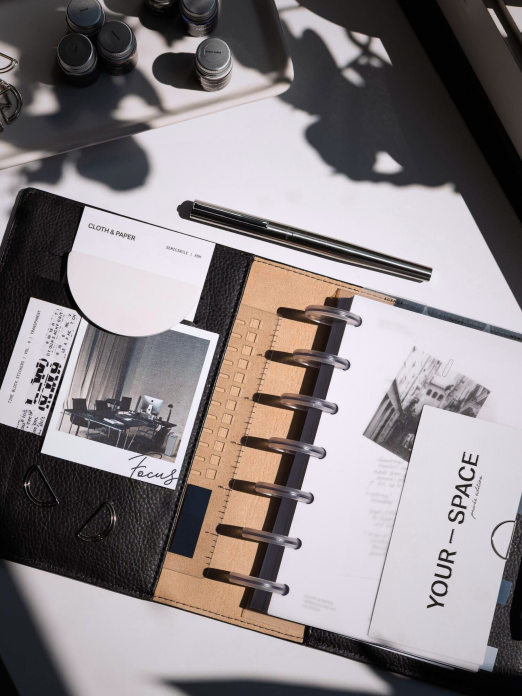
That’s why I only use discbound and ring systems. They’re the real MVPs for flexible, ADHD-friendly planning. Add a page. Remove a page. Move yesterday’s plan to today because you were spiraling and took a four-hour doomscroll break.
Try all the inserts. Mix and match. Change every month. This is your planner to build and rebuild however you want. The planner police will not come for you.

Step 4: Make it Visible
You need to bake in visible success. Give yourself built-in cues that make you interact with your planner and whisper “Hey… remember this?” without yelling.
Here’s a few tricks:
- Keep your planner open AT ALL TIMES in a place where you have to see it all day
- Use page flags to draw your attention to the most important tasks. Any of our Page Flags will do; transparent, bold, neutral, aesthetic….it’s not about the color, it’s about the cue.
- Use checkboxes or colorful markers to check off or cross out everything. Don’t just write “Work on project.” Write “Open project doc.” Then “Write intro.” Then “Take break.” Boom! Three checkmarks for one task. Feel that dopamine?
Your planner should feel like a collaboration with your future self, not a punishment for your current one.

Step 5: Romanticize the Ritual, Not the Routine
You don’t need a perfectly color-coded morning routine. You need a moment to reset with intention. And maybe a snack.
Pick one ritual that makes your planning time feel good:
- Light a candle
- Put on a playlist that says “I’m a woman with a vision”
- Use a fresh insert and a pen that glides like butter
- Name your ritual something dramatic, like Executive Strategy Session or The Chaos Briefing. The branding helps, trust me.
This is your anchor. The vibe. The moment where the chaos gets collected and you remember: “Oh right, I’m not helpless or lazy. I’m just spicy-brained and slightly overstimulated.”

Step 6: Let It Evolve
Your planner is not a tattoo. You are allowed to change how you use it, scrap a layout that’s not working, or abandon a system entirely.
Didn’t plan for three days? Cool. Flip the page. You’re not behind. You’re just resuming the conversation.
Perfection is a lie told by pastel productivity influencers with spotless homes and a houseplant named Deborah. The goal isn’t aesthetic perfection; it’s function. A planner that works is one you keep coming back to even when (especially when) your brain is on fire.
Bonus Tip:
Create a section in your planner titled “Hard Stuff I Did This Week” It works. Trust me.

TL;DR: Your Planner Isn’t a Performance
It’s not about having the perfect spread or the prettiest handwriting. Progress counts even when it’s scribbled in pencil and covered in coffee stains.Start messy. Sort lightly. Let it evolve.
You’ve got the tools. You’ve got the page flags. You’ve got the inserts and the rings and the potential. Now all you need to do… is open it and use it in whatever way makes sense to your gloriously overactive, tab-happy, distraction-prone brain.
Somewhere in those scribbles, that chaos, and that half-colored mood tracker is a version of you who’s figuring it out. And honestly? She’s doing a damn good job.
Want more ADHD Planning Tips? Check out this playlist on YouTube Channel.


5 Kommentare
This is the best article I’ve read about adhd planning. BUT I saw portion about the ease of ring and disc bound I would love to try rings but I’m a lefty. Has there ever been a thought to make a small batch with the holes on the opposite side so the rings are out of the way for lefties
Sabrina Martinez
OUCH!! This blog and videos on ADHD was so convicting and inspiring. This is why I love my half letter and CP petite and common place notebook,so I can eventually get it together! :)
Alicia Branch
Best Tip: Leave your planner OPEN at all times! I felt this.HARD.lol. If I close my planner then it might take me hours to initiate to open it again. My mind palace is a special and colorful utopia. Thanks for the tips that keep me better organized. x0x0×0
Terrie Hoffman
This is the best ADHD approach to planning I’ve ever read. Thank you for making us feel seen and heard!
Christine
Sweet, enlightening relief. 😅
This is great planner peace advice for not only a lady with ADHD, but also for the sleep deprived stay~at~home mama, or the overburdened middle manager in her 50s.
Christina Baldwin
Hinterlasse einen Kommentar
Diese Website ist durch hCaptcha geschützt und es gelten die allgemeinen Geschäftsbedingungen und Datenschutzbestimmungen von hCaptcha.