Why Mid-Year Is Actually the Perfect Time to Start Planning
As the calendar flips to June, it is completely natural for our routines to experience a bit of visual clutter. The goals we added months ago might start to feel a bit repetitive. Some daily or weekly spreads might have been left blank during busy or restful weekends. You can feel a quiet sense of friction building up.
This is exactly why mid-year is actually the perfect time to start planning. You now have six months of lived experience to work with, and that is worth far more than a blank slate. Whether you are recalibrating the setup you are already using or quietly laying groundwork for what comes next, mid-year offers a rare kind of clarity. You are standing on a stump of everything you have already tried, and that vantage point lets you see what is actually worth carrying forward.
The Audit : Pondering What Serves You
When our schedule begins to shift, our immediate instinct is to look for a spark. We spend hours scrolling for new layouts or shopping for a new journal, assuming the tool itself needs an update.
Real mid-year planning is about auditing what you’ve already written down and evaluating its utility. To do this effectively, we first have to confront a psychological trap: the sunk cost fallacy.
If you find yourself forcing your way through habit trackers, maintaining complex daily logs, or chasing goals that don't fit your life anymore, it's probably because you think it would be a waste to stop since you have already spent a significant amount of time and energy on them. We treat our past effort like an investment we have to protect. But clinging to a goal that no longer serves you doesn't save your past resources. It just crowds out what you need today.
To break free from the trap, look back at your planner and put them through a quick diagnostic check. Ask yourself these three sincere questions:
- Am I tracking this because it helps me navigate my day, or because I like the look of a completed list?
- Does looking at this layout give me a sense of clarity, or a quiet wave of obligation?
- If I were starting fresh today, with zero history, would I choose to write this goal down?
Mid-year is the perfect season to give yourself explicit permission to pivot the goals or layouts that fail this check. Striking something out isn’t a sign of quitting; it is an active, protective choice to free up mental energy for what matters right now.
Try this! Grab a highlighter or a bold marker, and go through your planner to cross out defunct goals, old trackers, or routines that feel mismatched with your current life. Clear away the visual noise so you can see exactly where you stand today.
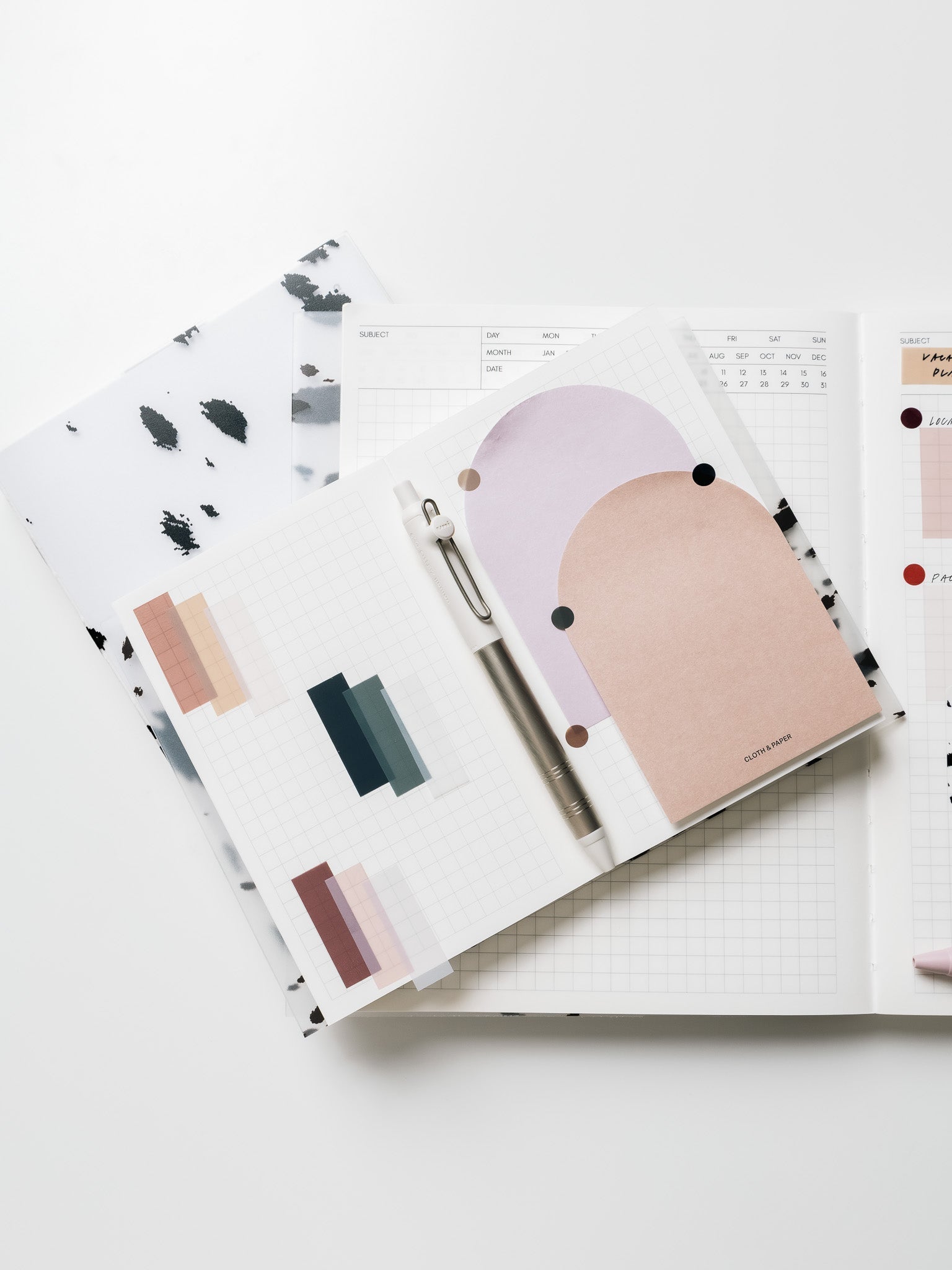
Once you've cleared the text, address the physical space. If those remaining empty pages trigger a sense of lingering incompletion, don't leave them open to stare back at you. Use a decorative sticker or a sleek sticky note to cover up old, overwhelming layouts, or literally use washi tape to seal past blank pages together. Create a physical, guilt-free boundary right inside your planner so your eyes naturally land only on the present.

Calibrating to Your Current Rhythm
Our energy levels and day-to-day obligations change with the seasons. A structured routine that worked beautifully a few months ago might feel too demanding during a hectic summer, or a minimalist layout might suddenly need more space to breathe.
Check if your planner layout matches your current energy baseline. If your current layout feels mismatched, adjust your system to match your current rhythm, whether you need to dial it back or step it up.
If your schedule feels heavy and you need to scale down:
Yes/No Tracker
Instead, draw a single line at the bottom of your weekly spread or use a small sticky note for one umbrella habit. Simply track "Movement (Yes/No)" or "Nourish (Yes/No)." If you walk for ten minutes or drink water, it’s a win!
Ivy Lee Method
Give yourself a chance to put your structured daily or weekly spreads on a temporary pause. Reach for a minimalist notepad or a single sticky note. Place the sticky note directly over your complex layout, or lay a notepad on your desk, and write down just 1 to 3 essential "Must-Dos" for the day. Keep the physical surface of your workspace incredibly light until your routine naturally stabilizes.
3-2-1 Logs
Mental clutter is inevitable, so try recording everything daily in a simple manner. Write down three things you learned (either from scrolling or chatting), two things you enjoyed (like food, music, or weather), and one thing to focus on tomorrow. Choose something outside work or obligations, something you simply want and can do with what you currently have.

If your schedule has opened up and you want to scale up: try The Sticky Stock Taking Method.
We're talking about those ideas that linger in your mind but are not immediately doable or urgent. When you have a sudden burst of summer inspiration, do not write them directly into your planner yet. Instead, turn the very front page of your planner, or an empty side panel, into a landing pad for sticky notes.
Group your ideas by category. Choose a colored sticky note, a design, or even a symbol to represent a different category, such as actions, wellness habits, or future milestones. Use whatever categories make sense for you. If you also have a sense of how long a task takes or what tools are needed, add those details as well.
Leave them parked on your front page as a dynamic menu. Then, as you move through your week, whenever a day opens up or you find yourself with an unexpected pocket of high energy, look at your inventory. Peel off a sticky note and drop it directly onto that day's open space to tackle it in real time. This keeps your layout structured and ambitious, but completely modular. It gives you all the thrill of doing more without the rigid pressure of pre-scheduling.

Sometimes scaling up also means checking the planning tool itself. If your current planner feels too small or rigid for everything you want to explore, or if you need a dedicated space to draft and think freely without disturbing your main layout, a Perfect Bound Notebook can serve as a quiet companion for unfiltered writing, lists, or rough plans.
And if you are already looking ahead, the 2027 Dated Inserts from the June Intention Box offer a compact way to test next year's structure without committing to a full system yet. Slip them into a Travel Notebook for an on-the-go rhythm that still holds what you have learned. The key is choosing a tool that matches where you are now, with enough flexibility to grow.

Fitting the System to Your Season
When the weather changes, we naturally adjust what we carry, switching to different layers that match the temperature outside. Just as we don’t feel a sense of failure for putting our winter wardrobe away, a routine or structure that supported you beautifully a few months ago isn't meant to be set in stone. If a layout is starting to create friction, it doesn't mean your system is broken, and it certainly doesn't mean you’ve failed. It just means your needs and priorities have shifted.
Mid-year is actually the perfect time to start planning because it is the exact moment we stop treating our systems like rigid rules, and start treating them like supportive layers. Let your pages change with you, and let them meet you exactly where you are today.



Laat een reactie achter
Deze site wordt beschermd door hCaptcha en het privacybeleid en de servicevoorwaarden van hCaptcha zijn van toepassing.